

Thermal insulation is no longer simply an additional construction feature. It is an important part of designing energy-efficient, comfortable, and durable industrial buildings. Factories, warehouses, cold storage facilities, pharmaceutical units, food-processing plants, and other temperature-sensitive facilities can experience significant heat gain through roofs and walls when the building envelope is not properly insulated.
During hot weather, solar radiation can heat the external surface of an industrial roof and increase the temperature inside the facility. This can place additional demand on air-conditioning, ventilation, and refrigeration systems. A properly designed insulated building envelope helps control heat transfer and maintain more stable indoor conditions.
According to the U.S. Department of Energy, the building envelope—including roofs and walls—plays an important role in building energy performance, and improving its thermal performance can help reduce energy consumption and improve comfort.
For modern industrial construction, PUR and PIR insulated sandwich panels offer an efficient way to combine structural enclosure with insulation. Durapuf manufactures sandwich panels designed for applications including industrial warehouses, factories, cold rooms, food processing, pharmaceuticals, logistics, and prefab structures.
Table of Contents
- What Is Thermal Insulation?
- Why Is Thermal Insulation Important for Industrial Buildings?
- 7 Benefits of Thermal Insulation
- Thermal Insulation with PUR Sandwich Panels
- Applications of Insulated Panels
- How to Choose the Right Insulation Solution
- Why Choose Durapuf?
- Frequently Asked Questions
What Is Thermal Insulation?
Thermal insulation is the use of materials or building systems that reduce the transfer of heat between two areas with different temperatures.
In an industrial building, insulation can be incorporated into the roof, walls, ceilings, cold rooms, partitions, and other parts of the building envelope. The objective is to reduce unwanted heat flow and help maintain the desired internal temperature.
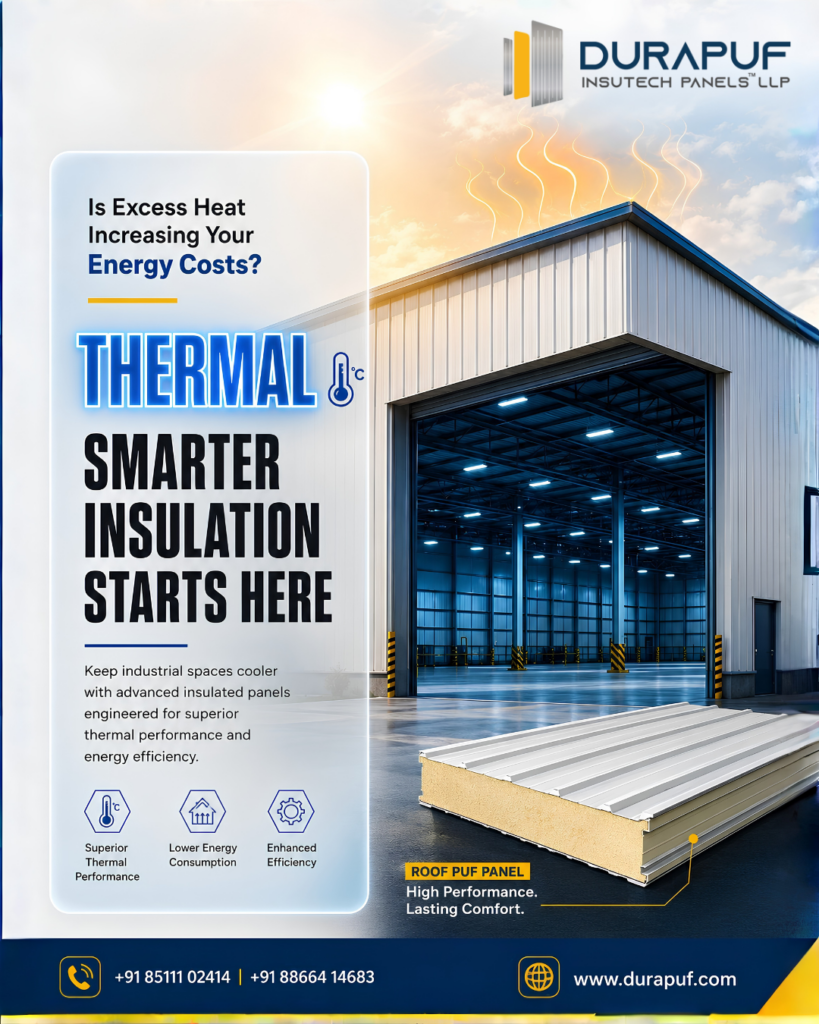
Modern insulated sandwich panels generally consist of an insulating core placed between two protective metal sheets. PUR, or polyurethane, is commonly used as an insulation core because of its low thermal conductivity and closed-cell structure.
Durapuf PUR sandwich panels use a rigid polyurethane foam core between metal facings such as PPGI, GI, or aluminium. The company lists panel thickness options from 30 mm to 100 mm, with custom thicknesses also available depending on project requirements.
Why Is Thermal Insulation Important for Industrial Buildings?
Industrial buildings can have large roof areas and substantial internal heat loads generated by machinery, production processes, lighting, refrigeration, and other equipment.
Without adequate insulation, heat can move through the building envelope and increase the demand for cooling systems. Conversely, in temperature-controlled facilities, unwanted heat transfer can make it more difficult to maintain a consistent internal environment.
Effective thermal insulation helps create a more controlled building envelope. This can contribute to:
- Better temperature stability
- Reduced cooling requirements
- Improved indoor working conditions
- More efficient refrigeration
- Better protection of temperature-sensitive products
- Lower long-term operating requirements
- Improved building performance
The U.S. Department of Energy describes continuous insulation as an important part of high-performance building envelopes because it can help reduce HVAC capacity requirements and operating costs.
7 Benefits of Thermal Insulation for Industrial Buildings
1. Helps Reduce Heat Transfer
One of the primary purposes of thermal insulation is to reduce the movement of heat between the exterior and interior of a building.
Industrial roofs are particularly exposed to direct sunlight. During summer, the roof surface can become significantly warmer than the indoor environment. An insulated roof panel creates a barrier that reduces the rate at which heat moves into the building.
This can help factories and warehouses maintain more consistent internal temperatures, particularly when combined with suitable ventilation and HVAC design.
2. Supports Lower Cooling Energy Consumption
Cooling large industrial spaces can require considerable energy. If excessive heat enters through the roof and walls, air-conditioning systems may need to operate for longer periods to maintain the desired temperature.
A properly selected insulation system reduces heat gain and can therefore support more efficient cooling.
This is particularly valuable for:
- Manufacturing plants
- Large warehouses
- Distribution centres
- Commercial buildings
- Food-processing facilities
- Temperature-controlled facilities
The U.S. Department of Energy notes that proper insulation is important for resisting unwanted heat flow and reducing heating and cooling costs.
3. Improves Indoor Temperature Stability
Temperature fluctuations can create operational challenges, especially in facilities where products, machinery, or processes require controlled conditions.
A well-insulated building envelope reduces the impact of external temperature changes. This allows HVAC and refrigeration systems to maintain the required internal environment more effectively.
For cold rooms and temperature-controlled facilities, this becomes even more important. Durapuf’s PUR sandwich panels are designed for applications such as cold storage, pharmaceutical facilities, food processing, and other temperature-controlled environments.
4. Improves Energy Efficiency
Energy efficiency is becoming an increasingly important consideration in industrial construction.
Reducing unnecessary heat transfer means mechanical cooling systems may not have to compensate for as much external heat gain. Over the operational life of a building, improving the envelope can therefore contribute to better energy performance.
Energy-efficient building design also supports wider sustainability goals. The Department of Energy highlights building-envelope improvements as an important pathway toward reducing energy consumption and improving building performance.
For businesses planning a new industrial facility, insulation should therefore be considered during the initial building design rather than treated as an afterthought.
5. Provides Long-Term Durability
Insulation is only valuable when the complete building system is designed and installed correctly.
Modern sandwich panels combine the insulating core with protective external sheets, creating a practical building-envelope solution. The metal facings provide structural protection while the insulated core helps control heat transfer.
Durapuf states that its PUR panels are designed with closed-cell foam, durable metal facings, and quality-control processes that include thermal conductivity, density, strength, bonding, and dimensional checks.
Correct panel selection, installation, joint detailing, drainage, and maintenance are all important for achieving long-term performance.
6. Supports Faster Industrial Construction
Traditional building methods can require separate structural, wall, roofing, and insulation processes.
Insulated sandwich panels integrate several functions into a single prefabricated component. This can simplify construction and help reduce the number of separate installation stages.
For projects where construction time is important, insulated panels can provide a practical alternative for roofs, walls, partitions, and temperature-controlled spaces.
Durapuf identifies quick installation as one of the advantages of its sandwich panel systems and supplies solutions for warehouses, factories, prefab structures, cold rooms, and other applications.
7. Creates Better Working and Operating Conditions
Temperature has a direct influence on the working environment inside industrial facilities.
Excessive heat can make large enclosed spaces uncomfortable for employees and can also affect equipment and production processes. Better thermal insulation can help create a more stable indoor environment by reducing the influence of external temperature changes.
For facilities operating sensitive processes or storing temperature-sensitive materials, maintaining controlled conditions can also be an important part of operational reliability.
Thermal Insulation with PUR Sandwich Panels
PUR sandwich panels are widely used where a combination of insulation, strength, speed of installation, and weather protection is required.
A typical PUR sandwich panel consists of a rigid polyurethane foam core positioned between two metal sheets. The closed-cell foam structure provides insulation, while the outer sheets provide protection and structural performance.
Durapuf’s published PUR sandwich panel specifications include approximately 0.022 W/mK thermal conductivity, density of approximately 38–42 kg/m³, and panel thicknesses ranging from 30 mm to 100 mm, with customization available. Actual project performance depends on the selected specification, design, installation, and operating conditions.
PUR Roof Panels
Roof panels are designed for industrial roofs where heat control, weather resistance, and structural performance are important.
They are suitable for applications such as:
- Industrial sheds
- Warehouses
- Manufacturing facilities
- Factories
- Commercial buildings
PUR Wall Panels
Wall panels can be used for external cladding and internal partitions. They provide an insulated building envelope while creating a clean and consistent appearance.
PUR Cold Room Panels
Cold room panels are designed for temperature-controlled spaces where maintaining stable internal conditions is critical.
They can be used in:
- Food storage
- Dairy facilities
- Pharmaceutical facilities
- Meat and seafood processing
- Cold-chain logistics
- Ripening chambers
Where Is Thermal Insulation Most Useful?
Different industries have different insulation requirements. A properly selected panel system can be adapted according to the building’s temperature conditions, dimensions, environment, and operational requirements.
Industrial Warehouses
Warehouses with large roof areas can benefit from insulated roofing and wall systems that help control heat transfer and indoor temperature.
Manufacturing Plants
Factories may experience significant internal heat generated by machinery and production processes. An insulated envelope can contribute to better environmental control.
Cold Storage
Cold storage facilities require effective temperature management. Insulated panels can help reduce unwanted heat transfer and support refrigeration efficiency.
Food Processing
Food-processing facilities require controlled, hygienic, and easy-to-maintain environments. Insulated panels can support these requirements.
Pharmaceutical and Clean Rooms
Temperature, humidity, cleanliness, and controlled conditions are important in pharmaceutical environments. Properly specified insulated panel systems can contribute to controlled spaces.
Prefabricated Structures
Insulated panels are also useful in prefab offices, site buildings, portable structures, and other applications where quick construction and energy performance are priorities. Durapuf lists these applications among its panel solutions.
How to Choose the Right Thermal Insulation Solution
Choosing the right insulation system should be based on the actual requirements of the project rather than simply selecting the thickest available panel.
Consider these factors:
- Required indoor temperature – Determine the temperature range that needs to be maintained.
- External climate – Local weather conditions influence insulation requirements.
- Panel thickness – Select thickness based on the required thermal performance and application.
- Core material – Compare PUR, PIR, and other insulation technologies according to project requirements.
- Facing material – GI, PPGI, aluminium, and coating options may be selected according to the environment.
- Joint system – Properly designed joints are important for controlling air and heat leakage.
- Fire performance – Evaluate the required fire-performance characteristics for the facility.
- Installation quality – Even high-quality panels can underperform if incorrectly installed.
- Maintenance requirements – Consider the operating environment and long-term maintenance plan.
A qualified manufacturer can help determine the appropriate panel configuration for the building.
Insulation can help reduce heat flow through a building envelope and support more efficient heating and cooling. The U.S. Department of Energy provides additional information about insulation and energy efficiency in buildings. Learn more about building energy efficiency.
Why Choose Durapuf for Thermal Insulation Solutions?
Durapuf Insutech Panels LLP specializes in premium PUR and PIR sandwich panels for industrial, commercial, and temperature-controlled applications.
Its product range includes roof panels, wall panels, and solutions for cold rooms. The company’s published applications include industrial warehouses and factories, food-processing and dairy plants, pharmaceutical and clean rooms, prefab structures, logistics facilities, ripening chambers, and pack houses.
Durapuf also highlights technical assistance, customized panel specifications, quality testing, installation support, and after-sales service as part of its offering.
For projects where heat control, energy efficiency, durability, and installation speed matter, selecting the correct insulated panel system can make an important difference to the overall building envelope.
Explore Durapuf’s PUR Sandwich Panels
Thermal Insulation: Key Benefits and Applications
| Benefit / Feature | Description |
|---|---|
| Reduced Heat Transfer | Helps minimize heat entering or leaving industrial spaces. |
| Lower Energy Consumption | Reduces cooling loads and supports better energy efficiency. |
| Temperature Stability | Helps maintain consistent indoor temperatures. |
| Improved Thermal Performance | Provides an effective barrier against external temperature variations. |
| Durability | Insulated panels provide a strong and long-lasting building-envelope solution. |
| Faster Installation | Sandwich panels can simplify and accelerate industrial construction. |
| Better Working Conditions | Helps create a more comfortable indoor environment for employees. |
| Multiple Applications | Suitable for factories, warehouses, cold rooms, food-processing units, pharmaceutical facilities, and prefab structures. |
| PUR Insulation | Provides a lightweight insulation core with low thermal conductivity. |
| Customized Solutions | Panel thickness, facings, and specifications can be selected according to project requirements. |
Frequently Asked Questions About Thermal Insulation
What is thermal insulation?
Thermal insulation is a material or building system designed to reduce heat transfer between areas with different temperatures. In industrial buildings, it is commonly incorporated into roofs, walls, cold rooms, and partitions.
Why is thermal insulation important for factories?
It helps reduce unwanted heat transfer, supports temperature stability, and can reduce the cooling load placed on HVAC systems.
Are PUR panels suitable for industrial buildings?
Yes. PUR sandwich panels are commonly used for industrial buildings, warehouses, factories, cold rooms, food-processing facilities, and other applications requiring insulation and durable enclosure systems.
What thickness of insulation panel should I choose?
The appropriate thickness depends on the application, indoor temperature requirements, external climate, building design, and required thermal performance. A panel manufacturer or qualified building professional should determine the appropriate specification.
Can insulated panels help reduce energy consumption?
Insulation reduces unwanted heat flow through the building envelope and can therefore support more efficient heating and cooling. Actual energy savings depend on the complete building design, HVAC system, climate, installation quality, and operating conditions.
Conclusion
Thermal insulation is an important consideration for modern industrial construction. From reducing unwanted heat transfer and supporting energy efficiency to improving temperature stability and construction speed, a properly designed insulated building envelope can provide benefits throughout the operational life of a facility.
PUR and PIR sandwich panels offer an integrated approach by combining insulation with durable external facings. They can be used across industrial warehouses, factories, cold rooms, food-processing facilities, pharmaceutical spaces, logistics buildings, and prefab structures.
For a project where temperature control, energy efficiency, durability, and installation efficiency are priorities, selecting the right insulated panel system should be part of the building design from the beginning.
Looking for a suitable insulation solution for your industrial project? Explore Durapuf’s insulated sandwich panel range and discuss your project requirements with its technical team.