

Industrial facilities are designed around productivity, efficiency, and continuous operations. However, machinery, production equipment, ventilation systems, and other industrial processes can generate considerable noise. If this noise is not properly managed, it can affect communication, concentration, comfort, and workplace performance.
Acoustic control is therefore becoming an important consideration in modern industrial construction. Properly selected insulated panel systems can contribute to a more controlled indoor environment while also providing thermal insulation, durability, and other performance benefits.
According to the U.S. Occupational Safety and Health Administration (OSHA), excessive workplace noise can interfere with communication and concentration, and engineering controls are among the methods used to reduce noise exposure.
1. Reduce Unwanted Industrial Noise
Acoustic control: Manufacturing facilities can contain multiple sources of noise, including machinery, compressors, production lines, fans, and other equipment. Continuous exposure to these sounds can make the workplace uncomfortable and make communication more difficult.
Acoustic control aims to reduce unwanted sound transmission and create a more manageable acoustic environment.
Insulated panel systems can be part of this approach when their construction and acoustic characteristics are appropriate for the application.
For industrial buildings, DURAPUF offers PUR sandwich panels designed for applications including factories, warehouses, food processing facilities, and temperature-controlled environments.
2. Improve Workplace Concentration
A quieter working environment can make it easier for employees to concentrate on tasks that require attention and precision.
Acoustic control: In manufacturing environments, workers may need to monitor equipment, communicate with colleagues, inspect products, or follow operating procedures. Excessive background noise can make these activities more challenging.
By considering acoustic performance during building design, facility owners can work toward creating a more comfortable environment for employees.
3. Support Better Communication
Acoustic control: Clear communication is particularly important in industrial facilities.
Employees may need to communicate instructions, report operational issues, coordinate production activities, or respond to warning signals. Excessive background noise can interfere with verbal communication.
OSHA notes that reducing workplace noise can improve communication and reduce noise-related risks.
Acoustic control should therefore be considered alongside other workplace safety and engineering measures rather than treated as simply a comfort feature.
4. Enhance Employee Comfort
Constant industrial noise can contribute to an uncomfortable working environment.
Acoustic control: Creating quieter areas within a facility can help improve the overall workplace experience. Depending on the application, acoustic insulated panels can be incorporated into walls, ceilings, partitions, and other building elements as part of an overall noise-control strategy.
However, panel selection should always be based on the actual acoustic requirements of the facility rather than assuming that every insulated panel provides the same acoustic performance.
5. Support Productivity and Operational Efficiency
Productivity depends on people as well as machinery.
When employees can communicate more easily, concentrate on their tasks, and work in a more comfortable environment, the workplace can operate more effectively.
Acoustic control is one component of a broader industrial building strategy that can include:
- Thermal insulation
- Fire-performance requirements
- Moisture control
- Hygiene
- Durability
- Energy efficiency
- Acoustic performance
This makes insulated panels particularly useful for facilities where several building requirements need to be addressed together.
6. Use Insulated Panels for Multiple Industrial Applications
Acoustic insulated panel solutions can be considered across different industrial environments, depending on the project’s requirements.
Manufacturing Plants
Acoustic control: Manufacturing facilities often have machinery and production equipment operating throughout the day. Panel systems can help create controlled internal environments while contributing to insulation requirements.
Warehouses
Large warehouses can experience sound reflection because of their size and hard surfaces. Appropriate building materials and acoustic treatments can help manage unwanted sound.
Food Processing Facilities
Food processing environments require cleanable and durable surfaces. Insulated panels can provide wall and ceiling systems, while acoustic requirements can also be considered during facility planning.
Pharmaceutical and Clean Room Facilities
These environments often require controlled temperature, hygiene, airtightness, and cleanable surfaces. Acoustic performance can be considered as part of the overall building specification.
DURAPUF’s website lists applications including cold storage, industrial warehouses and factories, food processing and dairy plants, pharmaceutical and clean rooms, prefab structures, and logistics facilities.
7. Choose the Right Insulated Panel System
Not every insulated panel is designed for the same application. Before selecting a panel, facility owners and project managers should evaluate the complete requirements of the building.
Panel Construction
The core material, metal sheets, joints, thickness, and overall construction can influence the panel’s performance.
Panel Thickness
Panel thickness should be selected according to the project’s thermal, structural, acoustic, and environmental requirements.
Installation Quality
Even a high-quality panel system can underperform if installation is not carried out correctly. Joints, gaps, penetrations, doors, windows, and connections should be properly addressed.
Application Requirements
A cold storage facility has different requirements from a manufacturing plant or warehouse. The panel system should therefore be selected according to the actual operating environment.
DURAPUF’s published specifications include PUF thickness options from 30 mm to 180 mm, with customized lengths available.
How DURAPUF Supports Modern Industrial Construction
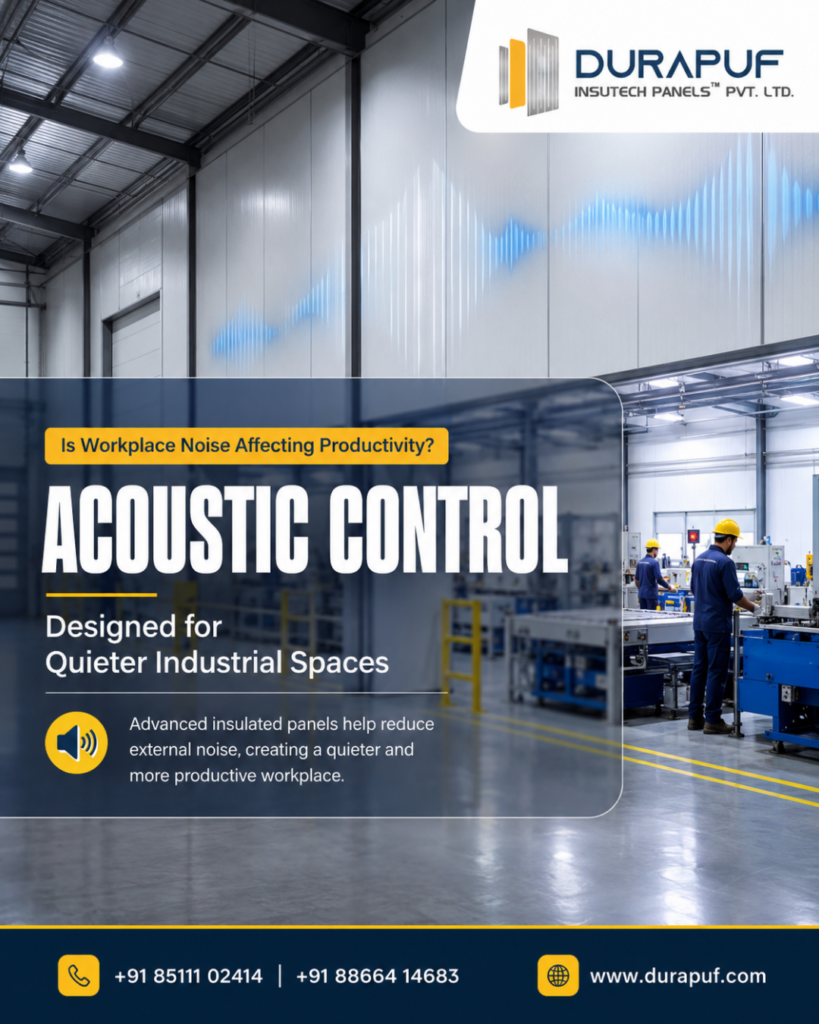
DURAPUF Insutech Panels Pvt. Ltd. provides PUR and PIR insulated panel solutions for industrial and commercial applications.
The company’s panel systems focus on thermal insulation, structural performance, durability, moisture and airtight construction, fire-retardant options, and acoustic insulation benefits.
For facilities where noise management is one of the project requirements, acoustic performance can be considered alongside thermal insulation, fire safety, hygiene, and durability when selecting the appropriate panel system.
You can also explore DURAPUF’s guide on how to identify high-quality PUF panels to understand important factors such as material quality, density, thickness, and insulation performance.
Acoustic Control Should Be Part of the Building Design
Noise control should not be treated as an afterthought in industrial construction. Excessive noise can affect communication, concentration, comfort, and workplace safety.
A comprehensive approach may combine equipment selection, maintenance, source isolation, barriers, appropriate building materials, and worker protection measures. OSHA identifies engineering controls such as barriers and isolating noise sources as methods for reducing workplace noise exposure.
Insulated panels can be one component of this wider strategy.
For manufacturing facilities, warehouses, food processing plants, pharmaceutical facilities, and other industrial environments, selecting the right panel system can help create a more controlled and efficient workplace.
SHA notes that reducing workplace noise can improve communication and help control occupational noise exposure. Learn more about OSHA’s occupational noise exposure guidelines.
Conclusion
A quieter industrial environment can support better communication, concentration, comfort, and productivity. Acoustic control should therefore be considered when planning walls, ceilings, partitions, and other building elements in industrial facilities.
With the right combination of building design, engineering controls, equipment management, and suitable insulated panel systems, businesses can work toward creating industrial spaces that are more comfortable and efficient.
A quieter space can contribute to stronger performance.
For insulated panel requirements, contact DURAPUF Insutech Panels Pvt. Ltd.
Phone: +91 85111 02414 | +91 88664 14683
Website: www.durapuf.com