


Introduction
In modern industrial construction, one issue quietly decides long-term success or failure—thermal efficiency. Whether it is a cold storage facility, a pharmaceutical unit, or a logistics warehouse, even small insulation inefficiencies can lead to massive energy loss over time.
This is exactly where PUF panel applications in industrial and commercial sectors become highly relevant. These panels are not just building materials; they are engineered insulation systems designed to control heat flow, reduce operational costs, and maintain stable internal environments.
In practical terms, most businesses don’t realize their electricity bills, product spoilage rates, or cooling system overloads are directly influenced by the type of insulation material used during construction. PUF panels solve this problem at the structural level itself.
What Are PUF Panels?
PUF (Polyurethane Foam) panels are composite insulated panels made by injecting rigid polyurethane foam between two metal sheets. This structure creates a lightweight but highly efficient thermal barrier.
In simple industry terms, they behave like a “sealed thermal jacket” for buildings. Unlike traditional brick or concrete walls, which allow gradual heat transfer, PUF panels significantly slow down temperature exchange between indoor and outdoor environments.
What makes them especially useful is not just insulation performance, but also their fast installation capability and adaptability across multiple industrial structures.
Why PUF Panel Applications Matter in Real Construction
Most people underestimate insulation because it is not visible once a project is completed. PUF Panel Applications. However, in real-world operations, insulation directly affects running cost and efficiency.
For example, in a cold storage facility, even a small rise in internal temperature can trigger compressor overloads. Over months, this leads to higher electricity consumption and reduced equipment lifespan. In pharma or food industries, it can also compromise product quality.
PUF panels help eliminate these risks by maintaining stable internal conditions. This is why modern EPC contractors and industrial developers increasingly rely on them instead of conventional construction methods.
10 High-Impact PUF Panel Applications in Industry
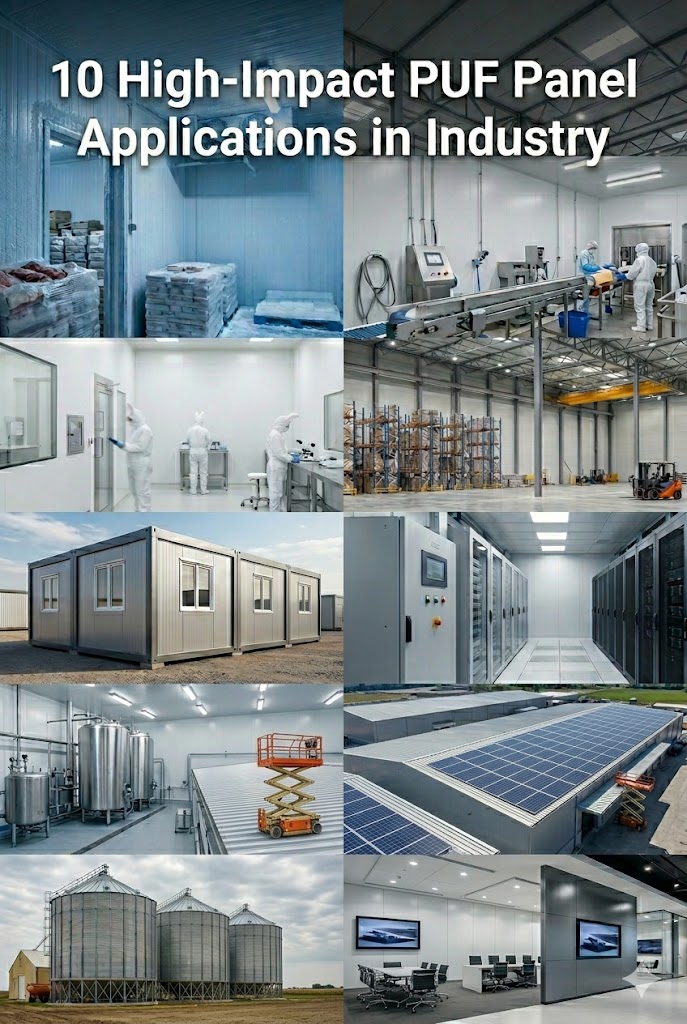
Cold Storage Facilities
Cold storage remains the most critical application of PUF panels. PUF Panel Applications These facilities require precise temperature control for perishable goods like fruits, vegetables, frozen food, and pharmaceuticals.
PUF panels help maintain stable internal temperatures by minimizing heat ingress from outside environments. In real-world operations, this directly reduces compressor workload and improves energy efficiency, which is one of the biggest cost factors in cold chain businesses.
Food Processing Units
In food processing environments, hygiene and temperature control go hand in hand. PUF panels are widely used in processing halls, packaging zones, and storage rooms because they create controlled environments that limit contamination risks.
From an industry standpoint, their smooth surface finish and moisture resistance make cleaning easier, which supports compliance with food safety standards.
Pharmaceutical Cleanrooms
Pharmaceutical manufacturing requires extremely controlled environments where even minor contamination can lead to production loss. PUF Panel Applications PUF panels are commonly used in cleanroom walls and ceilings because they provide sealed insulation and stable humidity control.
In real operations, these panels help maintain GMP-compliant environments, which is essential for regulatory approval and production consistency.
Warehouses and Logistics Hubs
Modern supply chains depend heavily on fast-built and scalable infrastructure. PUF Panel Applications PUF panels are increasingly used in warehouses because they reduce construction time significantly while offering long-term thermal stability.
In practical terms, they also help reduce internal heat buildup in large storage spaces, which indirectly lowers cooling requirements and operational costs.
Prefabricated Modular Buildings
One of the fastest-growing use cases of PUF panels is modular construction. Site offices, temporary labor housing, and mobile industrial units often rely on them due to their lightweight structure and quick assembly.
This allows companies to deploy infrastructure rapidly without compromising on insulation quality or durability.
Data Centers
Data centers are extremely sensitive PUF Panel Applications environments where temperature fluctuations can lead to equipment failure or downtime. PUF panels are used in walls and ceilings to reduce cooling loads and stabilize internal temperatures.
In real engineering terms, PUF Panel Applications contribute to better Power Usage Effectiveness (PUE), which is a critical metric in data center performance.
Dairy and Milk Processing Units
Milk storage and dairy processing require continuous PUF Panel Applications cold chain maintenance. PUF panels are widely used in these facilities because they help maintain hygienic and temperature-controlled environments for both processing and storage.
This reduces spoilage risks and ensures product consistency, especially in large-scale dairy operations.
Industrial Roofing and Wall Cladding
Factories and industrial sheds often face extreme heat exposure, especially in tropical climates. PUF panels are used for roofing and wall cladding to reduce heat absorption and improve internal working conditions.
From a workforce perspective, this also improves comfort levels and reduces machine overheating risks.
Agricultural Storage Units
Agricultural storage systems use PUF panels to protect grains, seeds, and other produce from humidity and temperature fluctuations. This helps reduce post-harvest losses, which is a major issue in agricultural supply chains.
In real terms, even small improvements in storage conditions can significantly increase product shelf life.
Commercial Buildings and Showrooms
In commercial architecture, PUF panels are used to improve energy efficiency and acoustic insulation. Retail stores, showrooms, and commercial complexes use them to maintain stable indoor environments with lower HVAC dependency.
This leads to reduced electricity consumption while improving customer comfort.
How PUF Panel Systems Work
PUF panels function on a simple but highly effective principle. The polyurethane foam core acts as a thermal barrier, while the outer metal sheets provide structural strength and protection.
Together, they reduce heat transfer by trapping air pockets within the foam structure. In real construction terms, this creates a highly controlled indoor environment regardless of external temperature conditions.
Who Should Use PUF Panels?
PUF panels are best suited for industries where temperature stability, energy efficiency, and fast construction matter. This includes cold chain operators, pharmaceutical manufacturers, food processing companies, logistics providers, and industrial infrastructure developers.
For decision-makers, the key advantage is not just performance but long-term operational savings.
Which Applications Deliver the Highest ROI?
Cold storage and pharmaceutical applications generally deliver the highest return on investment due to strict temperature requirements and continuous operation cycles. Warehousing and modular construction also offer strong ROI due to fast deployment and scalability.
In simple business terms, the more energy-sensitive the project, the higher the value of PUF panels becomes.
Learn how PUF panel applications improve insulation, reduce energy costs, and boost efficiency across industries like cold storage and warehousing — read more at https://www.energy.gov/energysaver/insulation
Why Choose Durapuf
Durapuf focuses on engineered insulation systems designed specifically for industrial reliability rather than generic construction use.
What differentiates such manufacturers is consistency in foam density, precision in panel bonding, and real-world performance under industrial load conditions. In insulation systems, even minor quality variations can lead to long-term energy loss, so manufacturing consistency becomes a critical factor.
Featured Snippet Answer (40–60 words)
PUF panels are insulated sandwich panels used in industrial and commercial buildings to reduce heat transfer and improve energy efficiency. They are widely used in cold storage, warehouses, cleanrooms, and modular buildings due to their durability, lightweight structure, and superior thermal insulation performance.
FAQs
What are PUF panel applications used for?
PUF panels are used in cold storage, pharma units, warehouses, industrial sheds, and commercial buildings for insulation and temperature control.
Why are PUF panels preferred in industries?
They offer better thermal efficiency, faster construction, and lower energy costs compared to traditional building materials.
Are PUF panels suitable for cold storage?
Yes, they are one of the most widely used materials for cold storage due to their excellent insulation performance.
How long do PUF panels last?
With proper installation, they can last for many years with minimal maintenance.
Do PUF panels reduce electricity bills?
Yes, they significantly reduce cooling and heating loads, which lowers overall energy consumption.
Conclusion
PUF panels have become a core material in modern industrial and commercial construction, not because they are trendy, but because they solve a very practical problem—energy loss and temperature instability. Across cold storage, pharmaceuticals, warehouses, data centers, and modular buildings, their role remains consistent: better insulation, lower operational cost, and faster project execution.
In real-world applications, the difference is not just structural—it is financial. Businesses that choose high-quality insulated systems tend to experience lower electricity consumption, improved product safety, and longer equipment life cycles. This is where proper material selection becomes a long-term investment rather than a short-term construction decision.
Companies like Durapuf reflect this shift toward engineered insulation systems designed for industrial reliability rather than basic construction use. As industries move toward energy-efficient infrastructure, PUF panels will continue to remain a foundational solution rather than an optional upgrade.
Final takeaway: If an industry depends on temperature control, efficiency, or rapid construction, PUF panel systems are no longer optional—they are essential.