

Why carry more steel than you need? For modern industrial construction, reducing unnecessary building weight can help improve material efficiency, installation, and overall project planning.
Lightweight PUF panels combine an insulated polyurethane core with metal facings to create a building-envelope solution that provides insulation without relying on heavy conventional wall and roof assemblies.
DURAPUF offers PUR and PIR sandwich panels for applications including industrial buildings, warehouses, cold storage, food-processing facilities, pharmaceutical and clean rooms, logistics facilities, and prefab structures. Its published specifications include PUF thicknesses from 30 mm to 180 mm, with customized lengths available.
In this article, we explore 10 powerful benefits of lightweight PUF panels for industrial buildings in 2026.
What Are Lightweight PUF Panels?
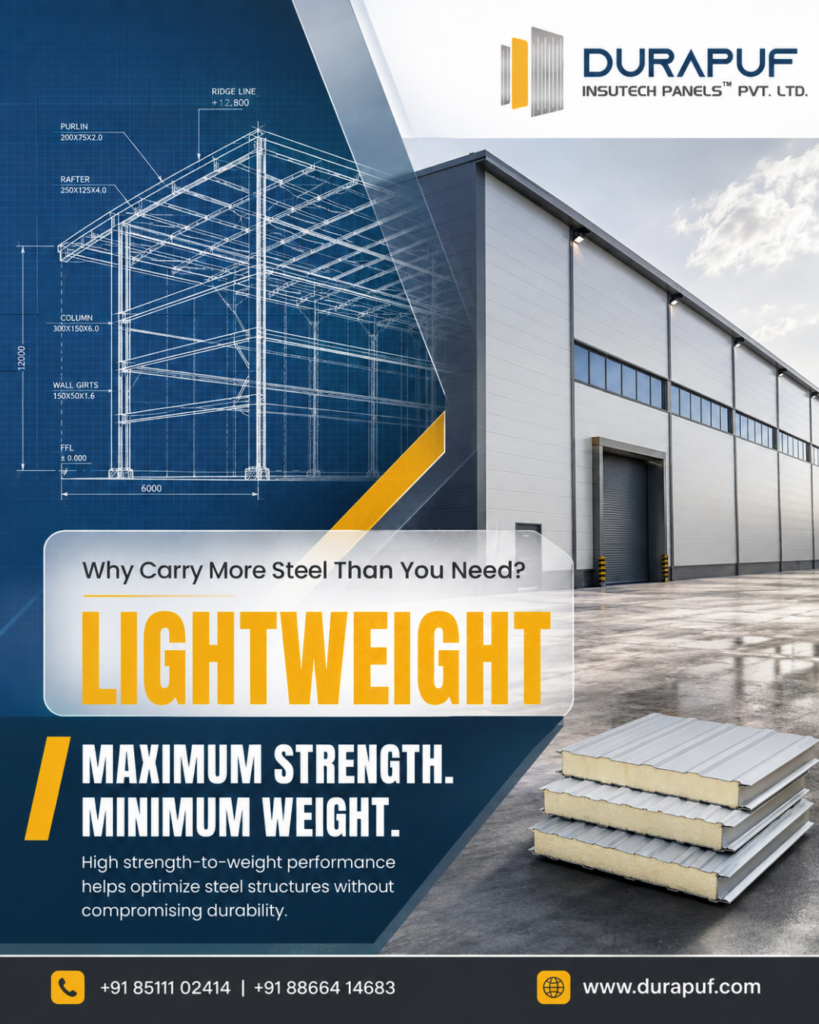
Lightweight PUF Panels: PUF panels are insulated sandwich panels made with a rigid polyurethane foam core between metal sheets.
The insulation core is integrated into the panel, allowing the roof or wall system to provide both enclosure and thermal insulation through a prefabricated component.
DURAPUF’s published specifications list a core density of 40 ± 2 kg/m³, PUF thicknesses from 30 mm to 180 mm, and customized panel lengths.
The exact panel specification should always be selected according to the project’s structural, thermal, environmental, and regulatory requirements.
Why Does Building Weight Matter?
Lightweight PUF Panels: Industrial buildings can involve large areas of roofing and wall cladding. The weight of these components can influence handling, transportation, supporting structures, and installation.
A lightweight insulated panel can provide a practical alternative where reducing unnecessary dead load is an important design consideration.
However, lightweight does not mean structurally independent. Panel spans, support spacing, fasteners, wind loads, structural framing, and installation conditions must all be evaluated by the project engineer.
The National Building Code of India 2016 includes provisions relating to structural design, loads, materials, prefabrication, and construction safety.
10 Powerful Benefits of Lightweight PUF Panels
1. Reduced Panel Weight
Lightweight PUF Panels. One of the most obvious advantages of an insulated sandwich panel is its relatively lightweight construction.
Instead of building separate layers for insulation and enclosure, PUF panels integrate the insulation core with metal facings.
This can make material handling easier during installation, subject to the panel dimensions and project conditions.
2. High Strength-to-Weight Performance
The goal of lightweight construction is not simply to reduce weight.
Lightweight PUF Panels: The more important consideration is achieving an appropriate strength-to-weight balance.
PUF sandwich panels combine rigid insulation with metal facings to create a manufactured panel system designed for roof and wall applications.
For an industrial project, engineers should evaluate:
- Panel thickness
- Panel span
- Support spacing
- Wind loading
- Fastener capacity
- Deflection requirements
- Joint configuration
- Local environmental conditions
A lightweight panel should always be selected according to the project’s engineering requirements.
3. Easier Material Handling
Large construction sites often involve significant quantities of roofing and wall materials.
Lightweight prefabricated panels can simplify handling and positioning compared with heavier individual construction components.
This can be particularly useful when panels need to be moved around an industrial site or lifted into position during installation.
Actual handling requirements will depend on panel dimensions, thickness, lifting equipment, and site conditions.
4. Faster Installation
Prefabrication is one of the major advantages of sandwich-panel construction.
PUF panels arrive as manufactured components rather than requiring the insulation and external enclosure to be constructed separately at the site.
This can help streamline:
- Material preparation
- Panel positioning
- Fixing
- Jointing
- Building enclosure
DURAPUF highlights fast and easy installation as a feature of its insulated panel solutions.
For industrial projects working with tight construction schedules, efficient installation can be an important advantage.
5. Integrated Thermal Insulation
A major benefit of PUF panels is that insulation is incorporated directly into the panel.
DURAPUF’s published specifications report thermal conductivity in the range of approximately 0.024–0.030 W/m°C for the referenced panel specification.
Thermal performance depends on factors such as panel thickness, joints, installation quality, openings, climate, and the complete building-envelope design.
For this reason, panel selection should be based on the required thermal performance rather than weight alone.
6. Reduced Construction Complexity
Traditional wall and roof assemblies can involve multiple materials and installation stages.
An insulated sandwich panel combines several functions into one manufactured component.
This can reduce construction complexity and make project coordination easier.
For warehouses, factories, logistics buildings, and other industrial facilities, a simpler building-envelope system can support more organized installation.
7. Efficient Use of Industrial Space
Industrial buildings often require large clear areas for machinery, storage, production, and movement.
Using an integrated roof and wall panel system can help create a clean building envelope while maintaining the required insulation and enclosure performance.
The final usable space, however, depends on the overall structural design and building layout.
8. Suitable for Multiple Industrial Applications
Lightweight insulated panels are not limited to one type of building.
DURAPUF identifies applications including:
- Industrial warehouses
- Factories
- Cold storage
- Food-processing facilities
- Dairy plants
- Pharmaceutical facilities
- Clean rooms
- Logistics facilities
- Prefab structures
- Ripening chambers
- Pack houses
This makes PUF panels a versatile option for different industrial building requirements.
9. Multiple Thickness Options
Industrial projects have different insulation and construction requirements.
DURAPUF’s published specifications list PUF thicknesses from 30 mm to 180 mm, along with customized lengths.
This allows project teams to evaluate different panel configurations based on:
- Thermal requirements
- Building application
- Climate
- Internal temperature
- Structural requirements
- Installation conditions
The appropriate thickness should be confirmed through project-specific calculations and technical specifications.
10. Efficient Building-Envelope Solution
The biggest advantage of PUF panels is that multiple requirements can be addressed through one integrated panel system.
A properly designed panel can contribute to:
- Thermal insulation
- Building enclosure
- Installation efficiency
- Weather protection
- Controlled internal environments
- Construction productivity
The overall result depends on the complete system, including the supporting structure, fasteners, joints, flashings, sealants, drainage, and workmanship.
Lightweight Does Not Mean Weak
This is an important distinction when evaluating PUF panels.
The term lightweight describes the weight of the panel. It does not mean that the panel can be selected without considering structural requirements.
For industrial buildings, engineers should evaluate the panel system against relevant design loads and project conditions.
These may include:
- Dead load
- Wind load
- Snow load where applicable
- Seismic considerations
- Panel span
- Support spacing
- Fastener capacity
- Deflection limits
- Temperature conditions
The Bureau of Indian Standards provides access to Indian Standards and building-related technical information.
How PUF Panels Compare with Conventional Wall Systems
| Factor | Lightweight PUF Panels | Conventional Multi-Layer Wall |
|---|---|---|
| Construction | Prefabricated | Multiple construction stages |
| Insulation | Integrated | Often installed separately |
| Handling | Relatively lightweight panel system | Depends on materials used |
| Installation | Fast panel installation | Can require multiple trades |
| Thermal performance | Integrated insulation core | Depends on selected insulation system |
| Applications | Industrial, commercial, cold storage and prefab | Broad construction applications |
| Customization | Thickness and dimensions can vary | Depends on construction method |
This is a general comparison. Actual performance depends on the selected materials and project design.
Lightweight PUF Panels for Warehouses
Warehouses need efficient building envelopes that protect stored goods and provide suitable internal conditions.
PUF panels can be used for warehouse roofs, external walls, partitions, and other insulated applications.
Their lightweight construction can also simplify handling and installation, while the integrated insulation core provides thermal performance.
For temperature-sensitive storage, the panel specification should be selected based on the required internal conditions.
Lightweight PUF Panels for Factories
Factories often require large enclosed spaces with efficient installation and appropriate thermal performance.
PUF sandwich panels can be used for factory roofs and walls to create an insulated building envelope.
The correct panel specification should consider:
- Factory processes
- Internal heat generation
- Temperature requirements
- Humidity
- Chemical exposure
- Fire requirements
- Cleaning requirements
- Environmental conditions
Lightweight PUF Panels for Cold Storage
Cold storage facilities require careful control of heat transfer.
PUF sandwich panels can provide an insulated enclosure around temperature-controlled areas.
For cold rooms, factors such as panel thickness, joint design, door construction, vapour control, and installation quality become particularly important.
DURAPUF provides PUR sandwich panel solutions for cold-storage and temperature-controlled applications. Explore DURAPUF PUR sandwich panels.
What Should You Check Before Choosing Lightweight PUF Panels?
Before purchasing PUF panels, evaluate more than just the panel price.
Check the Core
Review the insulation material, density, thermal conductivity, and other relevant technical properties.
Check Panel Thickness
Choose thickness based on the building’s thermal and application requirements.
Check Sheet Specifications
Review the top and bottom sheet thicknesses, material, coating, and finish.
Check Structural Requirements
Confirm panel span, support spacing, fasteners, wind loads, and deflection requirements.
Check Fire Performance
Fire performance should be evaluated against the building’s application and applicable standards.
DURAPUF’s published specifications distinguish between Normal PUR, FR-PUR, and PIR configurations with different fire classifications.
Check Testing and Documentation
Request relevant technical datasheets, test reports, and product documentation before finalizing specifications.
BIS provides a Know Your Standard platform where users can search Indian Standards by IS number or keyword and access related standard information.
You can review the official BIS standards information when evaluating applicable standards.
How to Get the Best Performance from Lightweight PUF Panels
The panel itself is only one part of the building system.
For better project performance:
- Select the correct panel thickness.
- Confirm structural support spacing.
- Use suitable fasteners.
- Follow the manufacturer’s installation procedure.
- Properly seal panel joints.
- Install appropriate flashings.
- Provide effective roof drainage.
- Protect panels during transportation and storage.
- Inspect installation quality.
- Maintain the building envelope regularly.
Correct installation is essential because poor joints, damaged facings, incorrect fasteners, or inadequate sealing can affect the performance of the complete system.
Why Choose DURAPUF PUF Panels?
DURAPUF’s published product information covers PUR and PIR sandwich panels for industrial and commercial applications.
Its published specifications include:
- PUF thickness: 30–180 mm
- Core density: 40 ± 2 kg/m³
- Customized panel lengths
- Multiple sheet-thickness options
- Thermal conductivity specifications
- Water-absorption specifications
- Service-temperature range
- Different fire-performance classifications
For a specific project, the latest technical datasheet and application-specific recommendations should be obtained directly from the manufacturer.
Visit DURAPUF to explore its insulated panel solutions.
Frequently Asked Questions
Are PUF panels lightweight?
PUF sandwich panels are designed as integrated insulated panels with a rigid polyurethane core and metal facings. Their weight depends on panel thickness, dimensions, facings, and core properties.
Are lightweight PUF panels strong?
A lightweight panel can provide appropriate performance when correctly designed and supported. Strength depends on panel construction, span, support spacing, fasteners, loads, and installation.
Do lightweight PUF panels reduce construction time?
They can help simplify handling and installation because the insulation and external facings are integrated into a prefabricated panel.
What is the standard thickness of PUF panels?
There is no single standard thickness for every application. DURAPUF’s published range is 30 mm to 180 mm, with customized lengths available.
Are PUF panels suitable for warehouses?
Yes. PUF sandwich panels are used for industrial warehouses and other insulated building applications.
Are PUF panels suitable for factories?
Yes. They can be used for factory roofs, walls, partitions, and other building-envelope applications, subject to project-specific design requirements.
Can PUF panels be used for cold storage?
Yes. Insulated PUR panels are used in cold-storage and temperature-controlled applications. The appropriate thickness and joint system should be selected according to the required operating conditions.
Does lightweight mean the panel is less durable?
Not necessarily. Panel durability depends on the core, metal facings, coatings, joint system, environmental exposure, installation, and maintenance—not weight alone.
Conclusion
Maximum strength does not always require maximum weight.
For modern industrial construction, lightweight PUF panels can offer an efficient combination of insulation, prefabrication, manageable handling, and building-envelope performance.
Their integrated construction can simplify installation while providing thermal insulation for applications ranging from warehouses and factories to cold storage, food processing, pharmaceutical facilities, and logistics buildings.
However, the right panel should always be selected based on engineering requirements, panel thickness, thermal performance, structural loads, fire requirements, environmental exposure, joint design, and installation quality.
If you’re planning an industrial building and want to reduce unnecessary panel weight without compromising the required performance, explore DURAPUF’s PUF sandwich panel solutions.