

Avoid costly cold storage panel mistakes. Learn key industry errors, expert insights, real case study & improve efficiency while reducing energy loss.
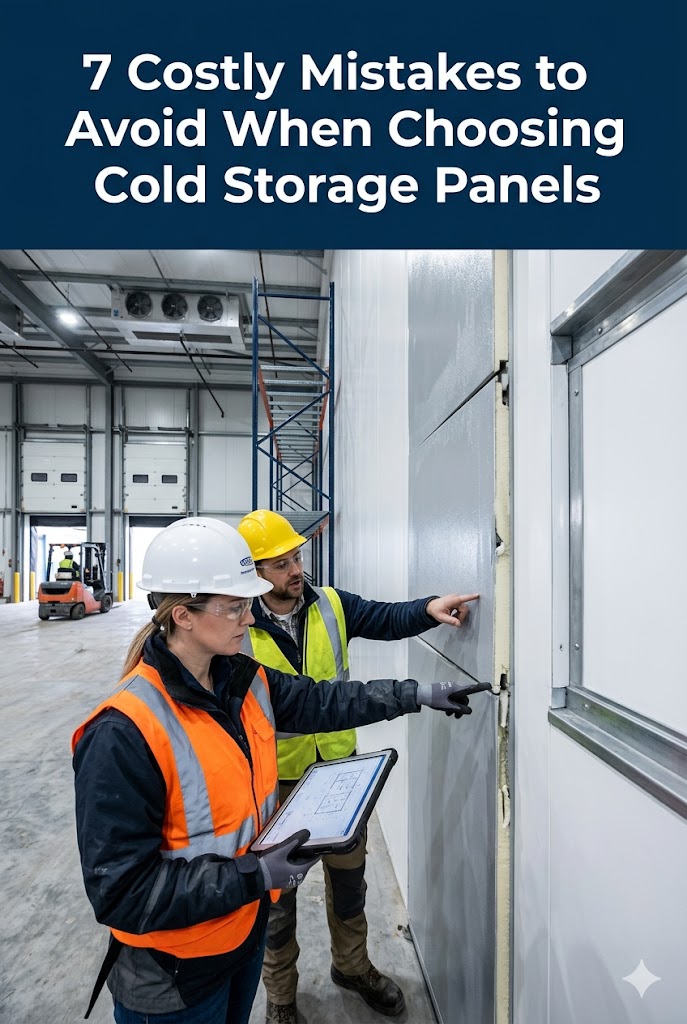
Table of Contents
- Introduction
- Cold Storage Panels: Industry Overview
- Why Cold Storage Panels Decide Efficiency
- Market Insights & Real Industry Data
- 7 Costly Mistakes Explained in Detail
- Manufacturing & Engineering Breakdown
- Real Case Study (Cold Storage Failure vs Success)
- Who Should Invest in Cold Storage Panels
- Which Panel Type Works Best
- Industry Challenges Most Blogs Ignore
- Expert Recommendations
- Future Trends in Cold Storage Infrastructure
- FAQs
- Conclusion
Introduction
Cold storage infrastructure is often misunderstood. Most business owners believe refrigeration systems determine performance, but in real industrial environments, the largest efficiency losses come from insulation failures in cold storage panels.
Across food processing units, dairy plants, pharmaceutical warehouses, and logistics hubs, cold storage panels silently control energy efficiency, product safety, and operational cost. Yet, they are usually the most underestimated component during planning.
Industry studies show that poorly designed insulation systems can increase energy consumption by 20% to 40% annually. In high-volume cold chain operations, this translates into millions in long-term operational losses.
This article breaks down the 7 most costly mistakes in cold storage panels, backed by real-world manufacturing insights, industry behavior, and a practical case study.
Cold Storage Panels: Industry Overview
Cold storage panels are engineered sandwich panels used to construct temperature-controlled environments. They typically consist of:
- External metal skin (PPGI / stainless steel/aluminum)
- Rigid insulation core (PUF or PIR)
- Protective coating system
Their function is simple but critical: minimize thermal conductivity and prevent heat ingress.
In industrial terms, these panels form the entire “thermal envelope” of a cold storage system. If this envelope fails, refrigeration systems must compensate continuously, increasing energy consumption and reducing equipment lifespan.
Globally, the cold chain industry is expanding rapidly due to:
- Rising frozen food consumption
- Pharmaceutical cold storage demand (vaccines, biologics)
- Export-driven agriculture logistics
- Urban supermarket expansion
India’s cold chain market alone is projected to grow at over 12% CAGR through 2030, increasing pressure on efficient infrastructure design.

Why Choose Durapuf
Durapuf is built for industries where thermal stability, energy efficiency, and long-term durability are critical. Its precision-engineered insulated panels reduce heat loss, maintain consistent temperatures, and improve cooling efficiency through tight joint systems and controlled-density cores. For sectors like food processing, pharma, dairy, and logistics, this means lower energy costs, better compliance, and reliable cold storage performance over time.
Why Cold Storage Panels Decide Efficiency
Cold storage efficiency is not determined by cooling capacity alone. It depends heavily on thermal resistance stability over time.
Panels act as a barrier between two environments: extreme cold inside and fluctuating ambient temperature outside.
If the insulation is weak, the refrigeration system compensates by running longer cycles. This creates:
- Higher electricity bills
- Compressor wear and tear
- Temperature fluctuations
- Product quality risks
In real-world operations, insulation quality can account for up to 35% of total cold storage operating efficiency.
Market Insights & Real Industry Data
From industrial reports and field installations:
- Energy cost in cold storage operations = 30–60% of total operating expense
- Poor insulation increases cooling load by 15–25%
- Improper installation contributes to 20%+ system inefficiency
- Maintenance costs rise by 10–18% annually in low-quality panel systems
This shows a clear pattern: most inefficiencies are not mechanical—they are structural.
7 Costly Mistakes in Cold Storage Panels (Deep Industry Breakdown)
1. Selecting Panels Only Based on Price
This is the most common and expensive mistake in the industry.
Low-cost panels often use lower-density insulation foam, which initially looks similar but performs poorly under continuous thermal stress.
In real operations, this leads to gradual energy leakage that is not immediately visible but builds up over months. Businesses often realize the issue only when electricity bills increase significantly or cooling consistency drops.
2. Ignoring Thermal Design Requirements
Cold storage is not a one-size-fits-all system. Each application requires specific insulation thickness and material selection.
For example:
- Frozen food storage requires high insulation resistance
- Pharma storage requires strict temperature stability
- Dairy requires moderate but consistent cooling
When design is generalized, systems become inefficient from day one.
3. Weak Panel Joint Engineering
Panels are only as strong as their joints.
Even premium insulation materials fail if joint systems allow micro-air leakage. In industrial environments, these micro gaps lead to:
- Condensation formation
- Ice buildup in freezer environments
- Mold growth in humid zones
- Gradual thermal degradation
This is one of the least visible but most damaging failures.
4. Ignoring Coating & Corrosion Resistance
Cold storage environments often involve humidity, cleaning chemicals, and temperature cycling.
Poor external coatings degrade over time, especially in coastal or high-humidity regions. Once corrosion begins, insulation integrity is indirectly compromised.
5. Overlooking Thermal Conductivity (K-Value)
Many buyers focus on thickness but ignore thermal conductivity values.
A technically advanced panel with a lower K-value performs significantly better than a thicker but low-quality panel.
In engineering terms, thermal conductivity defines real efficiency, not just physical size.
6. Improper Installation Execution
Installation is a critical performance factor.
Even perfectly engineered panels fail if:
- Alignment is incorrect
- Gaps are left between joints
- The structural frame is uneven
- Sealants are improperly applied
Industry observations show installation issues can reduce efficiency by up to 30%.
7. No Future Expansion Planning
Cold storage systems are long-term assets, but many businesses design only for current demand.
When expansion becomes necessary:
- Systems require partial dismantling
- Energy efficiency drops after modifications
- Structural compatibility issues arise
This leads to unnecessary capital expenditure.
Manufacturing & Engineering Breakdown
Cold storage panels are manufactured through controlled lamination processes where insulation foam is injected between metal sheets under pressure.
Key engineering factors include:
- Foam density consistency
- Adhesion strength
- Moisture resistance
- Fire-retardant properties (for PIR systems)
Modern panels also include cam-lock systems for better sealing in modular cold rooms.
Real Case Study: Cold Storage Failure vs Success
Case 1: Poor Panel Selection (Mid-Sized Dairy Facility)
A dairy processing unit in Western India installed low-cost PUF panels to reduce initial setup cost.
Within 8 months:
- Energy bills increased by 27%
- Ice formation occurred near panel joints
- Cooling cycles ran continuously
The issue was traced back to low-density insulation and improper sealing.
Total correction cost was nearly 40% higher than initial savings.
Case 2: Optimized Panel System (FMCG Cold Chain Unit)
A logistics cold storage facility used high-grade PIR panels with proper joint engineering and installation supervision.
Results after 1 year:
- 22% lower energy consumption
- Stable temperature variance (< ±1°C)
- Reduced maintenance downtime
This demonstrates how correct panel selection directly impacts long-term profitability.
Who Should Invest in Cold Storage Panels
Cold storage panels are essential for:
- Food processing companies
- Frozen food brands
- Pharmaceutical manufacturers
- Dairy plants
- Export logistics companies
- Cold chain startups
Any business dealing with perishable goods requires a stable thermal infrastructure.
Which Panel Type Works Best
| Type | Efficiency | Fire Resistance | Cost | Use Case |
|---|---|---|---|---|
| PUF | Medium-High | Medium | Low | General storage |
| PIR | Very High | High | High | Pharma & critical storage |
| EPS | Low | Low | Low | Temporary storage |
PIR is increasingly becoming the preferred choice in high-performance cold chain systems.
Industry Challenges Most Blogs Ignore
Most content ignores real operational challenges, such as:
- Temperature inconsistency due to door openings
- Moisture accumulation in high-humidity zones
- Long-term foam shrinkage effects
- Joint fatigue under thermal cycling
- Lack of trained installation labor
These factors significantly influence system performance.
Expert Recommendations
Industry experts emphasize three core principles:
- Do not compromise on insulation density
- Always validate thermal conductivity values
- Treat installation as engineering, not labor work
These three factors alone determine long-term system success.
Future Trends in Cold Storage Infrastructure
The industry is moving toward:
- AI-monitored temperature systems
- High-efficiency PIR panels
- Modular expandable cold rooms
- Energy-efficient hybrid cooling systems
- Sustainable insulation materials
Sustainability and energy optimization are becoming key decision drivers.👉 For energy efficiency standards in cold storage systems, refer to official guidelines:
https://powermin.gov.in/en/content/energy-efficiency
FAQs
What is the biggest mistake in cold storage panels?
Choosing low-quality insulation based only on cost instead of performance.
Which panel is best for cold storage?
PIR panels offer the highest efficiency for critical storage applications.
How do panels affect energy consumption?
Poor insulation increases heat transfer, forcing refrigeration systems to consume more power.
Why do cold storage systems fail?
Mostly due to poor panel selection, weak installation, and lack of sealing.
Conclusion
Cold storage panels are not construction materials—they are long-term energy infrastructure components. Most operational inefficiencies in cold storage systems come from avoidable design and selection mistakes.
Understanding these 7 costly mistakes in cold storage panels helps businesses reduce energy waste, improve operational stability, and significantly extend system life.
In modern cold chain economics, insulation quality is not a cost—it is a long-term performance investment.