

Introduction (Problem + Reality Check)
Industrial roofing in India is quietly going through a major transition. For decades, conventional metal sheets were considered “good enough” for factories, warehouses, and production units. Insulated PUF Roof Panels. They were affordable and easy to install, which made them the default choice for most builders.
But real-world performance has exposed their limitations. Excessive heat inside buildings, high cooling costs, and constant maintenance issues have started affecting operational efficiency. In many industries, roofing is no longer just a construction decision—it has become an energy and cost management issue.
This is where Insulated PUF Roof Panels are increasingly being adopted. The shift is not driven by trend, but by measurable operational benefits that directly impact profitability.
What are Insulated PUF Roof Panels?
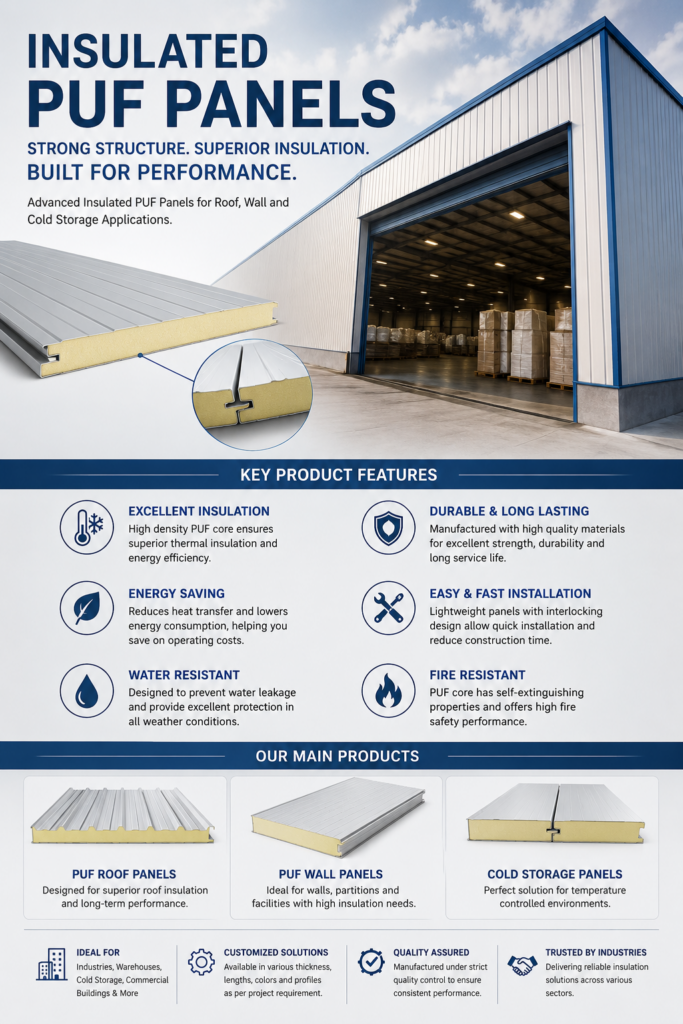
Insulated PUF roof panels are engineered sandwich panels made with a rigid polyurethane foam core placed between two metal sheets, usually GI or PPGI. This structure is designed to reduce heat transfer and maintain internal temperature stability.
In simple industrial terms, these panels act like a thermal barrier between external weather conditions and indoor working environments. Unlike conventional roofing that absorbs and transfers heat quickly, PUF panels slow down heat flow significantly, making them ideal for temperature-sensitive industrial operations.
Why Indian Industries are Switching to PUF Roof Panels
The biggest reason behind this shift is operational efficiency. Industries today are under pressure to reduce energy consumption while maintaining productivity levels. Insulated PUF Roof Panels. Conventional roofing systems increase internal temperatures, forcing HVAC systems to work harder, which directly increases electricity bills.
PUF panels, Insulated PUF Roof Panels, solve this problem at the structural level. By reducing heat gain, they reduce dependency on cooling systems. In real-world applications like warehouses and manufacturing plants, this can lead to noticeable energy savings over time.
Another overlooked factor is worker productivity. Excess heat in factories affects concentration, machine efficiency, and even product quality in sensitive sectors like food processing and pharmaceuticals. PUF panels help maintain a more stable working environment, which indirectly improves output consistency.
How the System Works in Real Conditions
The working principle is based on thermal resistance. When external heat hits the outer metal surface, it tries to travel inside the building. However, the polyurethane foam core acts as an insulating layer that slows down this heat transfer significantly.
As a result, the inner surface of the panel remains relatively stable compared to conventional roofing. This reduces indoor temperature fluctuations and minimizes the load on air conditioning systems. Over time, this translates into lower energy consumption and reduced operational stress on cooling equipment.
When Industries Should Consider PUF Panels
PUF roofing is particularly useful in environments where temperature control directly affects business performance. Cold storage units, logistics hubs, food processing facilities, and pharmaceutical plants are some of the most common adopters.
However, even general manufacturing units in hot climates are increasingly switching to insulated roofing because of rising electricity costs. In regions where summer temperatures remain high forInsulated PUF Roof Panels long durations, conventional roofing becomes a long-term operational disadvantage.
Who Benefits the Most from This Shift
Industrial owners, EPC contractors, and warehouse developers benefit the most from this transition. Startups setting up manufacturing units also gain long-term advantages because they avoid future retrofitting costs related to insulation upgrades.
In practical terms, businesses that operate high-energy environments or temperature-sensitive production lines see the fastest return on investment from insulated roofing systems.
Conventional Roofing vs PUF Panels (Real Comparison Insight)
Conventional roofing systems may still look cheaper during initial construction, but they often lead to higher lifecycle costs. Heat absorption increases electricity consumption, and frequent maintenance becomes unavoidable due to weather exposure.
PUF panels, on the other hand, are designed for long-term performance. While initial investment is higher, the reduction in energy consumption and maintenance requirements makes them more cost-efficient over time. Many industries now evaluate roofing decisions based on total cost of ownership rather than installation price alone.
Brand Perspective: Why Specialized Manufacturers Matter
In the industrial insulation space, product quality and engineering precision play a critical role in performance. Companies like Durapuf focus specifically on insulated panel systems designed for industrial applications.
What separates such manufacturers from generic suppliers is consistency in insulation density, structural accuracy, and customization options for different industrial requirements. Insulated PUF Roof Panels In real projects, these factors directly influence energy performance and durability over time.
About Durapuf
Durapuf is a manufacturer specializing in insulated panel systems used in industrial and commercial construction. The company focuses on improving thermal efficiency, structural durability, and long-term energy performance for buildings such as warehouses, cold storage facilities, and manufacturing units. Its engineered solutions are designed to reduce heat transfer, helping industries maintain stable indoor temperatures while lowering overall energy consumption and operational costs.
Featured Snippet (Direct Answer – 50–60 words)
Insulated PUF roof panels are sandwich panels with a polyurethane foam core used for thermal insulation in industrial buildings. Indian industries are switching to them because they reduce heat transfer, lower electricity costs, improve indoor working conditions, and offer better long-term durability compared to conventional metal roofing systems.
FAQs
What is the main advantage of PUF roof panels?
The main advantage is thermal insulation, which reduces heat transfer and lowers cooling costs in industrial buildings.
Are PUF panels better than metal roofing?
Yes, in most industrial applications because they offer better temperature control and energy efficiency.
Where are PUF panels commonly used in India?
They are widely used in warehouses, cold storage units, pharma plants, and manufacturing facilities.
Do PUF panels reduce electricity bills?
Yes, by reducing heat load, they significantly reduce HVAC energy consumption.
What is the lifespan of PUF roof panels?
Typically between 15 and 25 years, depending on installation quality and environmental conditions.
For a broader understanding of energy efficiency in industrial systems, refer to:
Ministry of New and Renewable Energy (MNRE) India
Conclusion
The shift toward insulated PUF roof panels in India is driven by practical industrial needs rather than design preference. Rising energy costs, operational inefficiencies, and demand for controlled environments are pushing industries to rethink roofing as a long-term investment rather than a construction expense.
For businesses planning industrial infrastructure, adopting insulated roofing systems is increasingly becoming a strategic decision tied directly to cost savings and productivity.
To explore engineered insulation solutions, visit Durapuf and evaluate how modern roofing systems can improve industrial performance over time.