

PIR Sandwich Panels: Fire safety in an industrial facility is not only about fire extinguishers, alarms, and emergency exits. The materials used to construct the building envelope can also influence how a fire behaves and how quickly heat and flames may spread.
PIR Sandwich Panels: For warehouses, manufacturing plants, cold storage facilities, food-processing units, pharmaceutical facilities, and other industrial environments, PIR sandwich panels can be considered when both thermal insulation and fire performance are important.
But choosing a panel simply because it is marketed as “fire-resistant” is not enough. Facility owners, architects, contractors and project engineers should understand the difference between reaction to fire, fire resistance, insulation performance and complete system performance before selecting a panel.
Durapuf develops PUR and PIR sandwich panel solutions for industrial, commercial and temperature-controlled environments, with a focus on thermal insulation, structural performance, fire safety and installation efficiency.
What Are PIR Sandwich Panels?
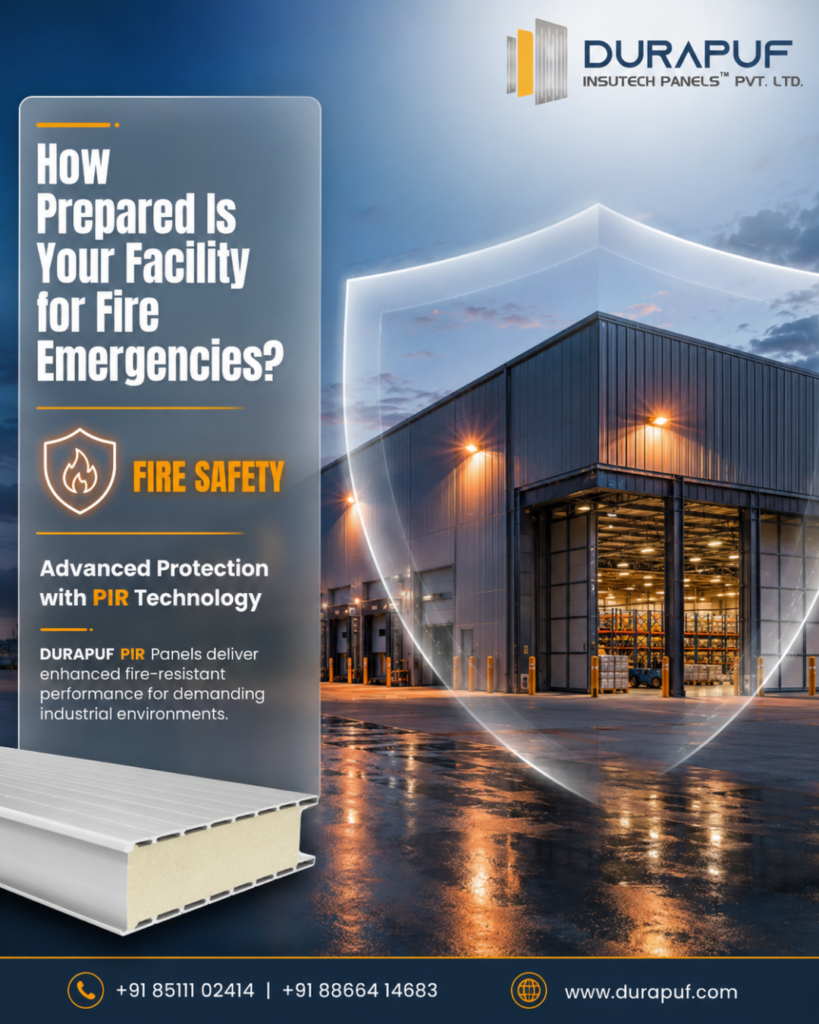
PIR sandwich panels are insulated building panels consisting of a rigid polyisocyanurate (PIR) insulation core between two protective metal facings.
The basic construction creates a lightweight building component that can be used for walls, roofs, partitions and other insulated applications. Depending on the panel design and project requirements, the external facings can provide mechanical protection, weather resistance and a finished architectural surface while the PIR core provides thermal insulation.
The main reason PIR panels attract attention in industrial construction is that they combine several requirements within one building component:
- Thermal insulation
- Structural performance
- Fast installation
- Moisture control
- Airtight construction
- Fire-performance considerations
- Clean and finished appearance
Durapuf’s published product information describes its sandwich panels as solutions for industrial factories, warehouses, cold storage units, commercial buildings and other temperature-controlled applications.
Why Is Fire Safety Important in Industrial Facilities?
PIR Sandwich Panels: Industrial buildings can contain electrical equipment, packaging materials, machinery, chemicals, fuels, stored goods or other combustible materials. The consequences of a fire can therefore extend beyond the immediate ignition point.
A well-designed fire-safety strategy aims to reduce the likelihood of ignition, control fire development, protect occupants and provide sufficient time for evacuation and emergency response.
PIR Sandwich Panels In India, the National Building Code of India 2016 includes provisions relating to fire prevention, life safety and fire protection. The Bureau of Indian Standards describes NBC 2016 as a comprehensive code covering fire-safety requirements along with construction, structural and building-service requirements.
PIR Sandwich Panels. However, fire safety should never be reduced to one material choice. A building’s overall performance depends on its construction, occupancy, fire detection and suppression systems, compartmentation, exits, electrical installation, emergency planning and the performance of individual building components.
This is why the question should not simply be:
“Is this panel fire resistant?”
A better question is:
“What documented fire performance does this specific panel system provide for my intended application?”
How Does PIR Contribute to Fire Safety?
PIR, or polyisocyanurate, is a thermoset insulation material that is chemically related to polyurethane but formulated differently to improve certain performance characteristics, including fire behaviour.
When used in a properly engineered sandwich panel system, PIR can provide a higher level of fire performance than many conventional combustible insulation options. However, the exact performance must always be assessed from the manufacturer’s test reports, classification documents and project-specific requirements.
Durapuf’s published brochure identifies PIR as DIN 4102 Class B1 and lists EN 13501-1 Class B for its PIR specification. These classifications are useful reference points, but the exact applicable rating should be confirmed against the current technical documentation for the product, thickness, and assembly being specified.
Reaction to Fire vs Fire Resistance: What Is the Difference?
PIR Sandwich Panels: This distinction is critical when evaluating insulated panels.
Reaction to Fire
Reaction to fire describes how a construction product behaves when exposed to fire.
PIR Sandwich Panels: The European EN 13501-1 classification system assigns reaction-to-fire classes ranging from A1/A2 through lower classes such as B, C, D, E and F. The classification can also include information concerning smoke production and flaming droplets or particles.
Therefore, a statement such as “Class B according to EN 13501-1” should not automatically be interpreted as “the wall will withstand fire for X minutes.”
These are different performance characteristics.
Fire Resistance
Fire resistance concerns the ability of a building element or assembly to maintain specified functions when exposed to fire for a defined period.
Depending on the application, fire-resistance assessments may involve characteristics such as:
- Integrity
- Insulation
- Load-bearing capacity
- Fire exposure direction
- Duration of resistance
The required performance depends on the building design, occupancy, local regulations, and the tested construction system.
For this reason, project teams should request the relevant test reports and classification documents rather than relying solely on generic marketing terminology.
What Should You Check Before Selecting Fire-Performance PIR Panels?
PIR Sandwich Panels: Selecting the right panel involves more than checking the core material.
1. Fire Classification
Ask the manufacturer for the applicable fire classification and the standard under which the product was tested.
For example, Durapuf’s published brochure provides fire-performance information for its PUR and PIR cores, including DIN 4102 and EN 13501-1 classifications.
The important point is to verify that the documentation corresponds to the actual panel specification being purchased.
2. Panel Thickness
Panel thickness affects thermal performance and can influence the overall behaviour of the panel system.
Durapuf’s brochure lists PUF thickness options ranging from 30 mm to 180 mm, with customized lengths available. The appropriate thickness should be selected according to thermal requirements, building design and application rather than simply choosing the thickest available panel.
3. Core Density and Quality
Consistent insulation-core quality is important for both thermal and structural performance.
For Durapuf’s published PUF specification, the brochure lists a core density of approximately 40 ± 2 kg/m³ and water absorption of ≤2% by volume, alongside closed-cell content of at least 90%. These figures apply to the published specification and should be verified against the specific product datasheet and test documentation for the project.
4. Metal Facings
The metal skins are an important part of the sandwich panel system.
Check:
- Sheet material
- Sheet thickness
- Coating
- Corrosion resistance
- Surface finish
- Joint configuration
- Manufacturing quality
A technically strong insulation core cannot compensate for poor detailing or inadequate protection of the complete building envelope.
5. Joints and Installation
Panel joints deserve particular attention.
Even a high-performance panel can lose some of its intended performance if installation is poor. Gaps, incorrectly installed flashings, damaged facings, penetrations and improperly detailed junctions can affect thermal performance, airtightness and the overall behaviour of the building envelope.
Installation should therefore follow the manufacturer’s approved method and the project’s architectural, structural and fire-safety requirements.
Where Are PIR Sandwich Panels Useful?
PIR sandwich panels can be relevant to several industrial and commercial environments where insulation and fire-performance considerations need to be addressed together.
Industrial Warehouses
Warehouses often require large insulated wall and roof surfaces. PIR sandwich panels can combine thermal insulation with rapid installation and a finished building envelope.
For facilities storing valuable goods, the material selection should form part of a broader fire-risk assessment rather than being considered independently.
Manufacturing Plants
Manufacturing facilities can have different fire risks depending on machinery, raw materials and production processes.
PIR panels may be considered for insulated walls, roofs and partitions where thermal performance, durability and fire characteristics are important.
Cold Storage and Cold Rooms
Cold-storage facilities require effective thermal insulation because refrigeration systems must continuously maintain the desired internal temperature.
Poor insulation or air leakage can increase the refrigeration load. Durapuf specifically lists cold storage and cold rooms among its applications.
For these facilities, panel selection should consider both thermal requirements and fire-safety requirements.
Food Processing and Dairy Plants
Food-processing facilities require hygienic, easy-to-maintain surfaces while also managing temperature and humidity.
Durapuf identifies food processing and dairy plants among its intended applications, alongside temperature-controlled environments and cleanable panel surfaces.
Pharmaceutical and Clean-Room Facilities
Pharmaceutical and clean-room environments place additional importance on airtightness, hygiene, temperature stability and controlled internal conditions.
Panel selection should therefore consider the entire wall or ceiling system, including joints, doors, penetrations, finishes and cleaning requirements.
Logistics and Ripening Facilities
Logistics centres, ripening chambers and pack houses may require controlled environmental conditions and efficient insulated construction.
Durapuf lists logistics, ripening chambers and pack houses among its application areas.
PIR vs PUR: Which Should You Choose?
PIR and PUR panels can both provide high levels of thermal insulation, but they should not automatically be treated as interchangeable for every project.
| Consideration | PIR Panels | PUR Panels |
|---|---|---|
| Thermal insulation | High | High |
| Fire-performance potential | Strong, depending on formulation and tested system | Depends on formulation and classification |
| Industrial applications | Yes | Yes |
| Cold-storage applications | Yes | Yes |
| Roof and wall applications | Available depending on product system | Available depending on product system |
| Selection priority | Fire + thermal + project requirements | Thermal + application + project requirements |
The correct choice depends on the project’s fire requirements, thermal target, environmental conditions, structural requirements, budget, applicable regulations and available certification.
Durapuf currently offers both PUR and PIR solutions, making application-specific selection more appropriate than treating one core as universally better.
A Practical Fire-Safety Checklist for Facility Owners
Before approving an insulated panel system, ask the supplier or project consultant for the following information:
- What is the exact core material?
- What is the panel thickness?
- What is the core density?
- What fire classification has been documented?
- Which testing standard was used?
- Does the classification apply to the complete panel or only the insulation core?
- Does the test correspond to the exact thickness and facing specification?
- What joint and fixing system was tested?
- Are there limitations on the tested application?
- What installation method is required?
- What documentation will be supplied with the product?
- Does the proposed system satisfy the project’s applicable fire-safety requirements?
This checklist is more useful than comparing panels solely on price per square metre.
Common Mistakes When Choosing Fire-Rated or Fire-Performance Panels
Mistake 1: Treating “Fire Resistant” as a Universal Rating
The phrase “fire resistant” is not enough to establish a specific performance level.
Always look for the actual classification, test standard, tested configuration and applicable limitations.
Mistake 2: Looking Only at the Core
A sandwich panel is a system. The facings, joints, fasteners, sealants, profiles and installation details can all affect performance.
Mistake 3: Choosing Thickness Only by Price
The cheapest panel may not provide the thermal or fire-performance characteristics required by the project.
Mistake 4: Ignoring Installation Quality
Poor joints and penetrations can compromise the intended performance of an otherwise suitable panel.
Mistake 5: Using Generic Test Results
A test result from another manufacturer’s panel should not be treated as proof of performance for a different product.
Ask for documentation relating to the actual product being specified.
Mistake 6: Treating Fire Safety as a Panel-Only Problem
Panels are only one component of a facility’s fire-safety strategy.
Detection, alarms, emergency exits, fire suppression, electrical safety, compartmentation, emergency procedures, and maintenance remain essential.
How to Make an Industrial Facility Better Prepared for Fire Emergencies
A more complete approach combines material selection with facility-level risk management.
Step 1: Identify Fire Hazards
Review stored materials, production processes, electrical systems, machinery and other potential ignition sources.
Step 2: Review the Building Envelope
Determine where insulated panels are being used and identify walls, roofs, partitions and areas requiring particular fire-performance consideration.
Step 3: Define the Required Performance
Work with the project fire consultant, architect or engineer to determine the applicable requirements.
Step 4: Compare Tested Products
Request technical datasheets, fire classifications, test reports and installation instructions.
Step 5: Verify the Complete Assembly
Do not evaluate the panel core in isolation. Review joints, fixings, penetrations, flashings and interfaces.
Step 6: Maintain the Building
Regular inspection matters. Damaged panels, penetrations, deteriorated sealants or poorly executed modifications should be addressed promptly.
Why Documentation Matters More Than Marketing Claims
For a facility owner, the most valuable information is not simply a claim that a panel is “advanced” or “fire resistant.”
The useful information is measurable and verifiable:
- Product specification
- Core type
- Density
- Thickness
- Thermal conductivity
- Fire classification
- Applicable testing standard
- Test report
- Installation requirements
- Application limitations
- Manufacturer documentation
European fire-classification frameworks also emphasize that products are considered in relation to their intended end use.
This principle is important for industrial construction in any market: the correct product must be matched to the correct application.
Why PIR Panels Can Be a Strategic Choice for Modern Facilities
Modern industrial facilities increasingly need to balance several objectives at the same time.
The building envelope must control heat transfer, withstand environmental conditions, support efficient construction, and contribute to an appropriate fire-safety strategy.
PIR sandwich panels can be useful in this context because they bring insulation and building-envelope functions together in a prefabricated panel system.
Durapuf’s published information highlights thermal insulation, structural strength, fire-retardant options, moisture and airtight construction, fast installation, and technical support as characteristics of its panel solutions.
The key, however, is specification. A good panel is only one part of a good building system.
Final Takeaway: Is Your Facility Really Prepared?
Fire preparedness begins before an emergency occurs.
For industrial warehouses, manufacturing plants, cold rooms, food-processing facilities, pharmaceutical units and logistics buildings, selecting appropriate insulated panels can form an important part of the building-envelope strategy.
PIR sandwich panels are worth considering when thermal insulation and fire-performance requirements need to be addressed together. But the right choice should always be based on documented product performance, the complete panel assembly, installation details and the requirements applicable to the specific facility.
Durapuf provides PUR and PIR sandwich panel solutions for industrial, commercial and temperature-controlled applications. If you are planning a new facility, renovation or insulated building envelope, the next step should be to discuss the project’s application, dimensions, insulation requirements and fire-performance requirements with the technical team before finalizing the panel specification.
Need help selecting the right insulated panel for your facility? Contact Durapuf for project-specific technical guidance and panel requirements.
In India, the National Building Code of India 2016 provides guidance covering fire safety, building construction and related safety requirements. NBC 2016 Part 4 specifically addresses Fire and Life Safety, including fire prevention, life safety and fire protection.
FAQs
Are PIR sandwich panels fire resistant?
PIR sandwich panels can provide strong fire-performance characteristics, but the exact performance depends on the formulation, panel construction, thickness, facings and tested assembly. Durapuf’s published brochure lists its PIR specification as DIN 4102 Class B1 and EN 13501-1 Class B. The applicable documentation should be checked for the exact product being specified.
What is the difference between PIR and PUR panels?
Both PIR and PUR are insulation-core materials used in sandwich panels. They can provide high thermal insulation, but their formulations and fire-performance characteristics differ. The appropriate option depends on the project’s thermal, fire, structural, and application requirements.
Are PIR panels suitable for warehouses?
Yes. PIR sandwich panels can be used for insulated walls and roofs in warehouse applications. However, the panel specification should be selected according to the warehouse’s thermal requirements, fire-safety strategy, stored materials and applicable building requirements.
Can PIR sandwich panels be used in cold storage?
Yes. Insulated sandwich panels are widely used in cold rooms and temperature-controlled facilities. Durapuf identifies cold storage and cold rooms as application areas for its panel solutions.
Does a fire classification mean a panel can withstand fire for a specific number of minutes?
Not necessarily. A reaction-to-fire classification such as EN 13501-1 is different from a fire-resistance rating for a complete building element. Always verify the specific test and classification applicable to the panel system.
What should I ask a PIR panel manufacturer before buying?
Ask for the technical datasheet, core specifications, panel thickness, density, thermal conductivity, fire classification, test documentation, facing specifications, joint details, installation instructions and application limitations.
What thickness of PIR panel should I choose?
There is no single thickness that is correct for every facility. The appropriate thickness depends on the required thermal performance, building design, internal temperature, external climate, application and other project requirements.
Are PIR panels suitable for pharmaceutical and clean-room facilities?
They can be suitable where the complete panel system meets the project’s hygiene, thermal, airtightness, surface-finish and fire-performance requirements. Pharmaceutical and clean-room projects should be designed around the complete building system rather than the insulation core alone.